Readability Checker
Paste your text to get a Flesch Reading Ease score, an estimated grade level and the average sentence length. This readability checker helps you write copy that visitors understand quickly.
Quick answer
Check how easy your text is to read with the Flesch Reading Ease score and grade level. Free readability checker for web content.
How to use it
- Paste a section of your content, ideally 100 words or more.
- Click Check readability.
- Read the score, level and words per sentence.
- Shorten long sentences and replace hard words, then test again.
How to read the score
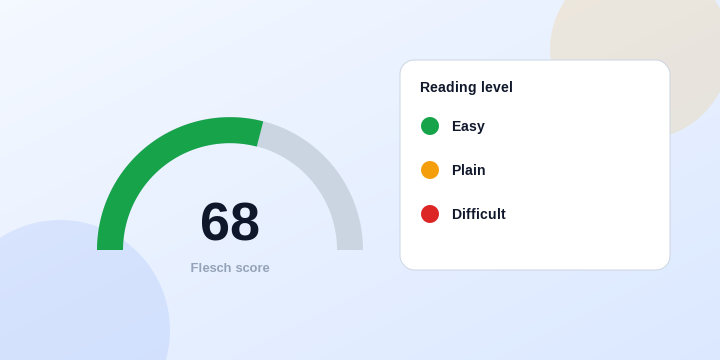
- 80 to 100: very easy, suits most readers
- 60 to 80: plain English, a good target for web pages
- 40 to 60: fairly difficult, fine for specialist topics
- Below 40: difficult, split sentences and simplify words
The Flesch Reading Ease formula uses the average sentence length and the average syllables per word. It is a guide, not a verdict, because it cannot judge accuracy or tone.
Why a readability checker helps SEO
Clear copy keeps visitors on the page, and it is easier for search engines and AI assistants to summarise. A good readability checker pushes you toward short sentences, common words and direct answers. Count the length of your draft with the word counter and test the whole page with our website SEO checker.
FAQ
What readability score should I aim for?
For most web pages a score between 60 and 80 is a comfortable target.
Does it work for Urdu or other languages?
No. The formula is built for English text.
Does readability affect rankings?
It is not a direct ranking factor, but clearer pages usually satisfy visitors better.
Need a custom tool or AI SEO help? See custom SEO tool development, our AI SEO services or message us on WhatsApp.
How this topic connects: the layers of free seo and marketing tools
Search engines and AI assistants understand a subject through connected ideas. This map shows where this page sits and what to read or compare next.
| Topic layer | What it covers | Where to go |
|---|---|---|
| Core | Readability Checker | This page |
| Topic hub | All free tools | Free tools |
| Tools and guides | Free resources for this topic | Free website SEO checker, Keyword density guide, UTM parameters guide |
| Next step | Get a written quote or help | Contact WCV Digital |
Questions answered on this page: What readability score should I aim for? | Does it work for Urdu or other languages? | Does readability affect rankings?
About WCV Digital and this page
WCV Digital is a Karachi-based digital agency (Plot H 7/12C, Block 3 Nazimabad, Karachi 74600) offering web design, development, software and SEO. The business operates under Wholesale (WCV) Ltd, registered in the United Kingdom with Company No. 16571122. Last reviewed: November 2026 by the WCV Digital team. Rules, platforms and tool features change, so confirm current details before you commit.
More free tools
What readability means
Readability is how easily a reader can understand your text on the first pass. It depends on sentence length, word choice and structure. A readability checker scores your text with well known formulas, such as Flesch Reading Ease, and shows the average sentence length and an estimated grade level. A higher reading ease score means simpler text, and most web content works best when an average adult can read it comfortably.
Clear writing is not simple writing. It is writing where each sentence has one job and the reader never has to read it twice.
How the score is calculated
Flesch Reading Ease uses the average number of words per sentence and the average number of syllables per word. Short sentences and short words raise the score. Long sentences and many long words lower it.
- 90 to 100: very easy, suitable for a young reader
- 60 to 70: plain English, ideal for most web content
- 30 to 50: difficult, common in academic writing
- 0 to 30: very difficult, for specialists only
For websites aimed at the public, try to stay between 60 and 70. For technical audiences, 40 to 60 can be acceptable if the structure is excellent.
Why readability matters for SEO and conversions
Visitors skim. If a page is hard to follow, they leave, and a high bounce rate on mobile is common when paragraphs look like walls of text. Easier pages keep people reading, which supports engagement and conversions. They are also easier for voice assistants and AI answer engines to quote, because short direct sentences make clean answers.
Practical ways to improve your score
- Split sentences longer than 20 words.
- Replace formal words with everyday ones: use instead of utilize, help instead of facilitate.
- Use active voice: We build sites, not Sites are built by us.
- Start paragraphs with the main point.
- Use lists and subheadings to break content.
- Cut filler such as very, really and in order to.
- Explain jargon the first time you use it.
Read your text aloud. Any place where you run out of breath is a sentence that needs splitting.
How to use the readability checker
- Paste your text into the box.
- Read the score, the grade level and the average sentence length.
- Find the longest sentences and shorten them.
- Recheck until the score fits your audience.
Use this tool with the word counter to balance length and clarity, and with the heading analyzer to check structure.
Writing for Pakistani and international readers
Many of your readers use English as a second language. Choose simple vocabulary, avoid idioms that do not translate, and keep sentences direct. This does not make your brand sound less professional. Large global companies write this way on purpose because it works for everyone, and it also makes translation into Urdu easier.
Limits of readability formulas
The formulas count only length, so they cannot judge accuracy, tone or logic. A very short, empty sentence scores well, and a precise technical term may lower the score yet be the right word. Treat the result as a guide, then edit by judgment.
Before and after example
Before: In order to facilitate the optimization of your website performance, it is imperative that you utilize a content delivery network. After: Use a content delivery network to make your site faster. The second sentence is shorter, uses everyday words and is far easier to scan, yet it carries the same meaning. Small rewrites like this lift a page score quickly.
Reading level and your audience
Pick a target before you write. A shop selling to the general public should aim for grade seven to nine. A page for engineers can run higher if terms are defined. Matching the level to the reader avoids both talking down and losing people with complexity.
Formatting that improves reading
Use short paragraphs of two to four lines, generous spacing, bold for key phrases and bullet lists for steps. Add a summary near the top of long pages. These layout choices do not change the formula score, but they make a visible difference in how comfortable the page feels on a phone.
A short editing routine
Edit in three passes. In the first pass, cut anything that does not help the reader. In the second pass, shorten sentences and swap complex words for simple ones. In the third pass, check formatting: headings, bullets, white space and bold key terms. Run the checker after each pass and watch the score move. Most pages improve noticeably after the second pass. Save the best versions as examples for your team, so everyone learns what clear writing looks like in your brand voice and can match it without a long style manual.
Readability for different page types
Service pages need short, confident sentences that explain the offer and the next step. Blog posts can use a slightly more relaxed rhythm, with examples and stories. Legal pages need accuracy first, but they still benefit from headings and plain terms. Product descriptions work best with a short opening line and a bulleted list of features. Run the checker on each page type and set your own target score for each one.
Free guide: write text people finish reading
Most web visitors skim. Easy text keeps them on the page, and easy text also helps search engines and voice assistants pick your answer. A Flesch score of 60 to 70 and a grade level of 7 to 9 suits most business pages.
Fix the long sentences first
The report lists every sentence over 25 words. Split each one at an "and", "but" or "which". Aim for an average of 15 to 20 words per sentence.
Prefer short, plain words
Swap "utilize" for "use", "assist" for "help" and "purchase" for "buy". The hard words list shows the long words worth replacing.
Cut passive voice and adverbs
"The report was sent by our team" becomes "Our team sent the report". Delete most -ly words. Use a stronger verb instead.
Shape the page for skimming
- Keep paragraphs to 2 to 4 lines
- Add a sub-heading every 150 to 250 words
- Use bullet lists for three or more items
- Put the answer in the first sentence
Editing routine
- Check the text and note the Flesch score
- Split every flagged long sentence
- Replace the top hard words
- Re-check and download the Excel report for your records
Questions people ask
What is a good Flesch score for a website?
A score between 60 and 70 suits most general audiences.
Does the tool work for Urdu text?
The formulas are designed for English. Roman Urdu will give rough results at best.
How long should my sentences be?
An average of 15 to 20 words works well, with a mix of short and medium sentences.
Does readability affect rankings?
It is not a direct ranking factor, but clear pages hold readers longer and earn more engagement.
Is the readability checker free?
Yes, free and unlimited.